
Introduction: Why Core Web Vitals Still Confuse People
Core Web Vitals are one of the most misunderstood parts of SEO.
Some teams obsess over Lighthouse scores and chase green numbers without understanding real user impact. Others ignore performance completely and hope content alone will carry rankings. Both approaches usually lead to disappointing results.
For service websites, performance is not about perfection. It is about removing friction. Faster pages build trust, reduce hesitation, and make it easier for users to take action.
This article focuses on what actually matters for service websites in 2026, based on real development and optimisation work, not theory.
If your website sells services rather than products, performance plays a much bigger role than most people realise.
What Core Web Vitals Really Measure
Core Web Vitals measure how real users experience your site, not how clean your code looks.
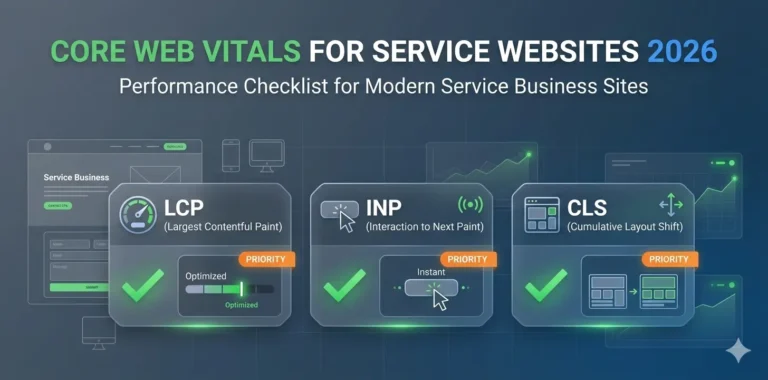
Google focuses on three metrics.
Largest Contentful Paint (LCP)
LCP measures how quickly the main content becomes visible.
For service websites, this is often:
- A headline explaining the service
- A hero image or banner
- A summary section above the fold
If this loads slowly, users feel the entire site is slow. Even strong copy cannot compensate for that first impression.
Cumulative Layout Shift (CLS)
CLS measures visual stability.
Unexpected movement caused by late-loading images, fonts, or scripts instantly damages trust. When buttons move while someone tries to click, frustration follows.
For service pages with contact forms and calls to action, layout stability is critical.
Interaction to Next Paint (INP)
INP measures how responsive your site feels during interaction.
This includes:
- Opening menus
- Clicking buttons
- Submitting forms
- Expanding sections
Slow INP makes a site feel unreliable, even if it looks visually polished.
Why Core Web Vitals Matter More for Service Websites
Service websites operate differently from blogs or ecommerce stores.
Users arrive with intent. They are comparing providers, evaluating credibility, and deciding who to contact. Performance issues interrupt that decision-making process.
Poor Core Web Vitals often lead to:
- Higher bounce rates
- Lower enquiry rates
- Reduced trust
- Difficulty ranking for competitive service keywords
This is especially visible on pages like SEO Services and WordPress Development Services, where users compare multiple providers in a short time.
If your site feels slow or unstable, users move on quietly.
Common Performance Mistakes That Hurt Rankings
Most performance problems are not caused by one big issue. They come from small decisions stacking up over time.
The most common ones include:
- Heavy themes with features that are never used
- Large images uploaded without optimisation
- Multiple font families and weights loading unnecessarily
- Too many third-party scripts and trackers
- Page builders used without restraint
Individually, these may seem harmless. Together, they quietly slow everything down and make optimisation harder later.
What Actually Improves Core Web Vitals in Practice
This is where real-world optimisation differs from generic advice.
Smarter Image Handling
Images are often the largest performance bottleneck.
What actually helps:
- Serving images at the exact size needed
- Using modern formats where supported
- Avoiding full-size images inside small containers
- Lazy loading images below the fold
Controlled Font Loading
Fonts are a hidden performance killer.
Better choices include:
- Limiting font families and weights
- Using font-display properly
- Avoiding fonts that are never used
JavaScript Discipline
JavaScript has a direct impact on INP.
Practical improvements include:
- Removing unused plugins and scripts
- Deferring non-critical JavaScript
- Avoiding stacked analytics and marketing tools
Hosting That Matches Your Audience
Cheap hosting often costs more in lost conversions.
Reliable hosting improves speed and stability, especially for service websites serving international users. Proper caching and global delivery make a noticeable difference.
This is where focused website performance optimisation creates measurable SEO and conversion gains.
Core Web Vitals and SEO Rankings in 2026
Core Web Vitals alone will not push a weak site to the top of search results.
However, they strongly influence:
- How competitive your pages can be
- How stable rankings remain over time
- How users behave after landing on your site
When multiple websites offer similar services, Google tends to favour the one users enjoy using more. Performance is part of that decision.
This aligns closely with broader SEO trends discussed in Shake It Off or Step It Up: The Future of SEO.
How Performance Directly Supports Conversions
Speed is not just an SEO metric.
For service websites, performance supports conversion psychology.
A fast site:
- Feels professional
- Builds confidence
- Reduces hesitation
- Encourages form submissions
When users land on a service page and everything responds instantly, they focus on your message instead of waiting.
This directly affects pages like Contact, where even small delays can quietly cost leads.
Measuring Core Web Vitals the Right Way
Tools matter, but context matters more.
Use a combination of:
- Google Search Console for real user Core Web Vitals data
https://search.google.com/search-console/about - Google PageSpeed Insights for diagnostics
https://pagespeed.web.dev/ - Real device testing whenever possible
Avoid obsessing over one score. Look for steady improvement trends and real-world user behaviour.
If you are updating older pages, performance improvements often amplify the gains explained in The SEO Edit (Taylor’s Version): Updating Old Content for Higher Rankings.
How Core Web Vitals Fit Into a Bigger SEO Strategy
Performance does not exist in isolation.
The strongest service websites combine:
- Clear site structure
- Strong internal linking
- Fast and stable performance
- Trust signals like reviews and case studies
- Clear conversion paths
Internal linking plays a key role here. Blogs that explain performance should naturally support services, just as shown in Blogging for Leads: How to Turn Readers into Clients.
Trust matters too. A fast site without credibility still struggles to convert. This connection is explored further in Reputation Remix: How Reviews, Testimonials & Trust Drive SEO.
Final Thoughts: Performance Is About Respecting Intent
Core Web Vitals are not about chasing perfection.
They are about respecting the user’s time and intent.
For service websites, good performance supports SEO, credibility, and conversions together. Ignoring it usually means working harder for weaker results.
If rankings feel unstable or enquiries are inconsistent, performance is often part of the problem.
A focused review can quickly show what actually needs fixing and what does not.