
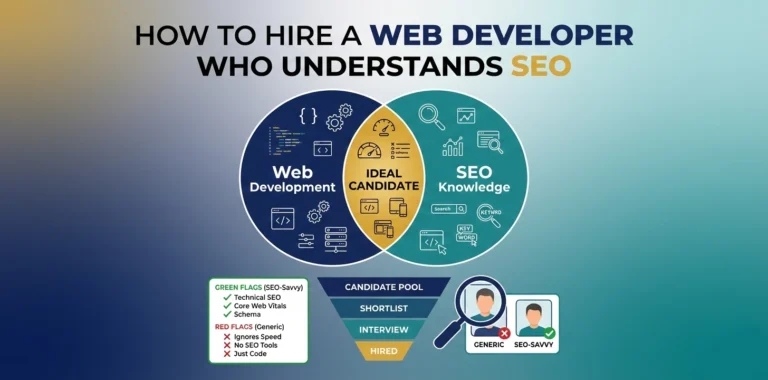
Introduction: Hiring the Right Developer for the Right Reasons
Most businesses do not hire the wrong web developer. They hire the right developer for the wrong reasons.
A visually polished website that loads slowly, struggles to rank, or cannot scale is usually the result of development decisions made without SEO in mind. Fixing those decisions later almost always costs more than building correctly from the start.
If your website is expected to generate leads, visibility, or revenue, SEO understanding is not optional. It influences how your site is structured, how fast it loads, how content is organised, and how easily it can grow.
This guide is written to help business owners and decision-makers understand what to look for when hiring a web developer who genuinely understands SEO, not just design trends or tools.
Why SEO Knowledge Matters in Web Development
SEO is not something you add after launch.
It is built into the foundation of a website, including:
- Site architecture
- URL structure
- Performance decisions
- Content hierarchy
- Internal linking
When these elements are wrong, even strong SEO campaigns struggle to deliver results. When they are done well, SEO becomes easier, more predictable, and more scalable.
This is why SEO-friendly website development consistently outperforms sites that treat SEO as an afterthought. The connection between structure and visibility is explained further in SEO-Friendly Website Development Checklist (2026 Edition).
Common Hiring Mistakes Businesses Make
Many businesses focus on surface-level criteria when hiring a developer.
Common mistakes include:
- Prioritising visuals over structure
- Choosing the cheapest quote without understanding scope
- Assuming SEO can be fixed later
- Relying entirely on page builders without asking why
- Not asking about performance or scalability
These choices often lead to sites that look good but underperform. Performance issues, indexing problems, and internal linking gaps usually surface months after launch.
At that point, fixes become reactive instead of strategic.
Early Red Flags to Watch For
Some warning signs appear before a project even begins.
Be cautious if a developer:
- Talks only about design, not structure
- Avoids questions about technical SEO
- Treats SEO as a plugin or add-on
- Cannot explain Core Web Vitals in simple terms
- Has no clear approach to internal linking
A developer does not need to be an SEO agency. However, they must understand how their decisions affect search visibility and user experience.
If performance is brushed off, that is often a sign of future issues. These issues are covered in detail in Core Web Vitals for Service Websites: What Actually Matters in 2026.
Questions That Reveal Real SEO Understanding
Asking the right questions quickly separates experience from guesswork.
Good questions include:
- How do you plan internal linking for service pages?
Look for answers that mention structure, relevance, and content relationships. - How do you approach site speed and performance?
A strong answer references image handling, scripts, fonts, and hosting decisions. - How do you structure URLs for SEO?
The developer should explain clean, logical URL planning without hesitation. - How do you handle redesigns without losing SEO value?
This reveals whether they understand redirects, content mapping, and crawl behaviour. - How do you measure success after launch?
Clear metrics like performance stability, indexing health, and conversions matter more than vague claims.
Confidence and clarity matter more than technical jargon.
What an SEO-Focused Web Developer Actually Delivers
An SEO-aware developer builds with intent, not assumptions.
That usually includes:
- Clean and crawlable site architecture
- SEO-friendly URL structures
- Performance-first development decisions
- Schema-ready templates
- Logical internal linking
- Easy scalability for future content
This approach is especially common in custom WordPress development, where flexibility and control are essential. You can see how content and structure work together in From Blank Space to Page One: Crafting SEO-Friendly Blogs.
The Difference You Notice After Launch
Websites built with SEO in mind tend to behave differently over time.
They usually:
- Rank more consistently
- Perform better on mobile devices
- Convert visitors more effectively
- Require fewer technical fixes
- Scale without forced rebuilds
These differences are most visible on competitive pages such as SEO Services, where small technical advantages compound over time.
Performance and user experience also improve conversion outcomes, which is explained further in Why Web Performance Matters and How to Make Your Site Faster (Swift-ly!).
Performance and SEO Go Hand in Hand
Performance is not just a technical concern. It affects how users perceive your brand.
A fast website:
- Feels more professional
- Builds trust quickly
- Reduces bounce rates
- Encourages enquiries
Developers who understand SEO treat performance as a core requirement, not a bonus feature. Tools like Google PageSpeed Insights help diagnose issues, but the real improvements come from development decisions.
Cost Clarity and Long-Term Value
An SEO-focused developer is rarely the cheapest option.
However, the cost usually reflects:
- Fewer rebuilds
- Lower long-term SEO spend
- Better performance stability
- Higher conversion rates
Paying slightly more upfront often prevents expensive fixes later. Many businesses realise this only after migrating away from limited platforms, a process discussed in The SEO Edit (Taylor’s Version): Updating Old Content for New Rankings.
SEO, Content, and Scalability
Hiring a developer who understands SEO also affects how content scales.
A strong technical foundation supports:
- Blogging strategies that generate leads
- Clear content clusters
- Logical expansion of services
- Easier content updates
This relationship between content and structure is explored further in Blogging for Leads: How to Turn Readers into Clients and The Archer’s Guide to Content Marketing: Aim Your Words to Convert.
Trust Is Built Through Technical Decisions
Trust is not just about testimonials or branding.
It is influenced by:
- Site speed
- Stability
- Accessibility
- Clear structure
When a site behaves predictably and loads quickly, users trust it more. This trust-performance link is covered in Reputation Remix: How Reviews, Testimonials & Trust Drive SEO.
Platform and development choices directly influence how easily trust can be built.
Which Businesses Benefit Most From SEO-Aware Developers
Hiring a developer who understands SEO is especially important if:
- Your website supports revenue
- You rely on organic traffic
- You operate in a competitive niche
- You plan to scale content or services
- Your site is a primary lead channel
For businesses where the website is central to growth, development decisions matter far more than launch speed alone.
Final Thoughts: Build the Foundation Before You Decorate
Hiring a web developer is not just about building a website.
It is about building a foundation your business can grow on.
A developer who understands SEO helps you avoid technical debt, reduces long-term costs, and creates a platform that supports visibility and conversions.
If you want clarity before committing, a short discussion around SEO-friendly website development, WordPress development services, or SEO services can quickly reveal whether expectations and approach are aligned.
A small conversation now is far cheaper than fixing problems later.