
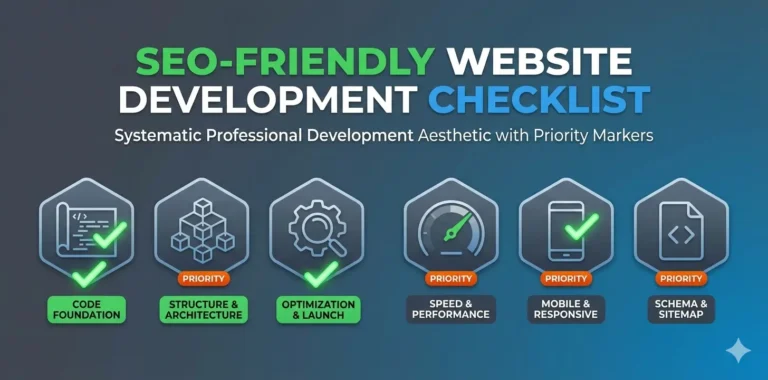
Introduction: SEO Starts Before the First Blog Post
Most SEO problems do not begin with keywords or content.
They begin with how a website is built.
After working on dozens of websites across different industries and regions, one pattern shows up again and again. Businesses invest heavily in blogs, ads, and SEO tools, yet their rankings remain unstable. When you look closer, the issue is rarely the content. It is the foundation underneath it.
Slow loading pages, poor internal structure, weak mobile experience, and technical gaps quietly limit performance. No amount of content can fully compensate for that.
This checklist is written from a developer’s point of view. It focuses on the technical and structural decisions that determine whether a website can rank, convert, and scale in 2026 and beyond.
If you are planning a new website or trying to understand why your current site struggles with SEO, this is the right place to start.
1. Build a Clear and Crawlable Site Structure
Search engines do not guess what your website is about. They rely on structure and internal relationships.
A clean structure helps search engines understand your core services and helps users navigate naturally between related pages.
Checklist for strong site structure
- Logical and readable URL hierarchy
- Core services close to the homepage
- No orphan pages with zero internal links
- One clear H1 per page
- Supporting pages linked contextually
Example of a clear hierarchy:
- /services/wordpress-development/
- /services/seo-services/
- /blog/seo-friendly-website-development-checklist/
Blogs should support services, not live in isolation. This is how informational content contributes to business growth.
If you are building or restructuring your site, this concept is explained further in From Blank Space to Page One: Crafting SEO-Friendly Blogs, which shows how structure and content work together.
2. Core Web Vitals Begin at Development Stage
Website performance is not something you fix after launch. It is shaped by development decisions from day one.
Google’s page experience signals continue to matter, especially in competitive industries.
Core Web Vitals benchmarks to aim for
- Largest Contentful Paint under 2.5 seconds
- Cumulative Layout Shift below 0.1
- Interaction to Next Paint under 200 milliseconds
From a development perspective, this usually involves:
- Reliable hosting with good server response times
- Properly sized and compressed images
- Controlled font loading
- Limited third-party scripts
- Avoiding bloated themes and unnecessary plugins
Chasing perfect Lighthouse scores is less important than improving real user experience. If real users feel delays, rankings usually follow.
This topic is covered in detail in Why Web Performance Matters and How to Make Your Site Faster (Swift-ly!), which breaks down practical performance fixes that actually work.
You can also validate performance using Google PageSpeed Insights
3. Mobile-First Is the Default Standard
Google indexes the mobile version of your site first. This has been true for years, but many websites still treat mobile as secondary.
An SEO-friendly website in 2026 must:
- Be fully responsive on real devices
- Use readable font sizes
- Maintain proper spacing for taps and clicks
- Avoid hiding critical content on mobile
- Load quickly on slower connections
If mobile users struggle to read, scroll, or interact, engagement drops and rankings follow.
Design and responsiveness are covered further in Master Responsive Design in 2025 with CSS Subgrid & Fluid Containers, which explains how modern layouts support both UX and SEO.
4. Technical SEO Basics That Cannot Be Skipped
Some SEO tasks are not exciting, but skipping them creates long-term problems.
Every SEO-ready website should include:
- XML sitemap submitted in Google Search Console
- Clean robots.txt file
- Proper canonical tags
- HTTPS with no mixed content warnings
- Correct 404 handling and redirects
These are not advanced tactics. They are foundations.
If these elements are broken or missing, even great content struggles to rank consistently. This is where strong technical SEO implementation makes a measurable difference.
You can manage and monitor many of these basics using Google Search Console
5. Structured Data and Schema Markup
Schema markup helps search engines understand context, not just text.
At a minimum, most service-based websites should implement:
- Organization schema
- Website schema
- Service schema
- Article schema for blogs
- FAQ schema where applicable
Schema improves eligibility for rich results and helps search engines interpret site structure faster.
Schema alone will not boost rankings, but missing or broken schema often limits visibility quietly.
If you want to understand why structured data has become essential, see Eras of SEO: From Keyword Stuffing to AI-Driven Strategies.
6. Internal Linking That Supports Real Goals
Internal linking is one of the most underused SEO levers.
A good internal linking strategy:
- Connects blogs to relevant service pages
- Uses descriptive anchor text
- Avoids excessive exact-match anchors
- Builds topical clusters naturally
For example, a blog about site performance should naturally reference pages related to WordPress development, SEO services, or audits where relevant.
This is how blogs support conversions instead of just collecting traffic.
You can see this strategy applied across content like Blogging for Leads: How to Turn Readers into Clients and The Archer’s Guide to Content Marketing: Aim Your Words to Convert.
7. SEO-Friendly Content Formatting
Developers influence readability more than they realise.
Good formatting improves engagement and helps search engines understand content hierarchy.
Make sure that:
- Headings follow a logical order
- Paragraphs stay short and readable
- Lists are used where helpful
- Images include meaningful alt text
- Content remains scannable
A fast site with poorly structured content still fails. Structure and clarity work together.
8. Pre-Launch SEO Checks
Before pushing a site live, always verify:
- Pages are indexable
- No accidental noindex tags exist
- Sitemap is accessible
- Analytics and Search Console are connected
- Major crawl errors are resolved
Missing this step is one of the most common reasons new websites struggle for months after launch.
Final Thoughts: Build SEO Into the Foundation
SEO-friendly website development is not about shortcuts.
It is about building a site that search engines can understand and users enjoy using.
When development, structure, performance, and content work together, SEO becomes easier, more stable, and more scalable.
If your website was built without these fundamentals, fixing them early saves time, money, and lost rankings later.
If you want clarity on where your site stands today, reviewing your technical foundation is always the smartest first step.