
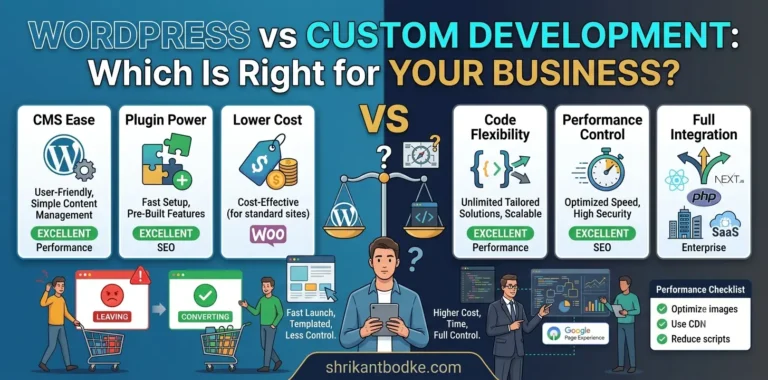
Choosing the right platform for your business website is one of the most important technology decisions you’ll make.
For many businesses, the debate comes down to two options: WordPress or custom web development.
Both approaches have their strengths, and neither is universally better. The right choice depends on your budget, business goals, scalability requirements, performance expectations, and long-term maintenance plans.
Over the years, I’ve worked on both WordPress and fully custom-built websites. Each project had different requirements, and the platform choice always depended on what would deliver the best business outcome, not simply what was popular.
In this guide, I’ll compare WordPress and custom development to help you decide which solution is right for your business.
What Is WordPress?
WordPress is the world’s most popular content management system (CMS), powering more than 40% of websites globally. According to the official WordPress website, it is designed to help individuals and businesses build flexible, scalable websites without starting from scratch.
It provides businesses with an easy way to manage content, publish blogs, update pages, and extend functionality using plugins.
WordPress is particularly suitable for:
- Business websites
- Blogs
- Portfolio websites
- WooCommerce stores
- Service-based businesses
- Small and medium-sized enterprises
If you’re already using WordPress and experiencing performance issues, read my guide on Why Your WordPress Website Is Slow (And How to Fix It).
What Is Custom Development?
Custom development involves building a website from the ground up using programming languages and frameworks such as:
- PHP
- Laravel
- React
- Next.js
- Vue.js
- ASP.NET
- Django
- Node.js
Everything is built specifically for your business requirements.
Instead of adapting your business around a CMS, the website is designed around your workflows.
Custom development is often chosen for:
- SaaS platforms
- Enterprise portals
- Internal business systems
- CRM solutions
- Large marketplaces
- Highly customised web applications
WordPress vs Custom Development Comparison
| Feature | WordPress | Custom Development |
|---|---|---|
| Initial Cost | Lower | Higher |
| Development Time | Faster | Longer |
| Flexibility | High | Unlimited |
| Performance | Excellent when optimized | Excellent when well-built |
| SEO | Excellent | Excellent |
| Maintenance | Easier | Developer required |
| Security | Good with best practices | Depends on implementation |
| Scalability | High | Very High |
| Content Management | Easy | Custom-built |
| Business Growth | Suitable for most businesses | Ideal for complex systems |
1. Development Cost
For many businesses, budget is the biggest deciding factor.
WordPress
Advantages:
- Lower development costs
- Faster deployment
- Thousands of plugins available
- Lower maintenance costs
Custom Development
Advantages:
- Built specifically for your business
- No unnecessary features
- Greater long-term flexibility
Disadvantages:
- Higher initial investment
- Longer development timeline
If you’re launching a typical business website, WordPress usually provides the best return on investment.
2. Performance
One common misconception is that WordPress is inherently slow.
That’s simply not true.
Most performance issues come from:
- Poor hosting
- Heavy themes
- Too many plugins
- Unoptimized images
- Lack of caching
A properly optimized WordPress website can achieve excellent performance.
You can measure your website’s performance using Google PageSpeed Insights, which analyzes loading speed, accessibility, SEO, and Core Web Vitals.
Learn more in my article Core Web Vitals Explained for Business Owners. Google also provides an in-depth explanation of these metrics on its Core Web Vitals documentation.
Custom websites also require optimization. Poor coding practices can make a custom application slower than a well-optimized WordPress site.
3. SEO
From an SEO perspective, both platforms can perform exceptionally well.
What matters is:
- Clean code
- Fast loading times
- Structured data
- Mobile responsiveness
- Internal linking
- Crawlability
Google also provides detailed guidance on technical SEO, crawling, indexing, and structured data in its Search Central documentation, making it an excellent resource for developers and website owners. Technical SEO plays a much bigger role than the platform itself.
If you’re interested in improving technical SEO, check out 10 Technical SEO Mistakes Developers Still Make in 2026.
4. Scalability
Many people believe businesses eventually outgrow WordPress.
In reality, WordPress powers websites for global brands and high-traffic publishers.
WordPress scales well when:
- Hosting is appropriate
- Caching is configured
- Database optimization is maintained
- Code quality is high
However, highly specialized applications with complex workflows may benefit from custom development.
5. Security
Security depends far more on maintenance than the platform itself.
Regardless of the platform you choose, following secure coding practices recommended by the Open Worldwide Application Security Project (OWASP) can help reduce common web security risks.
For WordPress:
- Keep plugins updated
- Update themes
- Use strong authentication
- Install SSL certificates
- Perform regular backups
For custom applications:
- Follow secure coding standards
- Regularly patch dependencies
- Validate user input
- Conduct security audits
Neither option is automatically more secure.
6. Ease of Content Management
This is where WordPress shines.
Marketing teams and business owners can:
- Publish blogs
- Edit pages
- Upload media
- Manage products
- Update content
…without needing a developer.
Custom websites often require administrative interfaces to be built from scratch.
7. Long-Term Maintenance
Every website requires maintenance.
For WordPress:
- Plugin updates
- Theme updates
- Security monitoring
- Performance optimization
For custom development:
- Framework upgrades
- Dependency management
- Bug fixes
- Feature development
Neither option is maintenance-free.
When Should You Choose WordPress?
WordPress is an excellent choice if you need:
- A business website
- A portfolio
- A blog
- A WooCommerce store
- Fast deployment
- Affordable development
- Easy content management
For most small and medium-sized businesses, WordPress is more than capable.
When Should You Choose Custom Development?
Custom development makes sense when your project involves:
- Complex business logic
- Custom workflows
- Enterprise software
- SaaS products
- Internal business systems
- Advanced integrations
- Unique functionality
Common Misconceptions
“WordPress isn’t professional.”
False.
Many enterprise websites use WordPress successfully.
“Custom websites always perform better.”
Not necessarily.
Poorly written custom code can perform worse than optimized WordPress websites.
“WordPress can’t scale.”
Incorrect.
With proper architecture and hosting, WordPress can handle significant traffic.
| If You Need… | Choose |
|---|---|
| Quick launch | WordPress |
| Lower development cost | WordPress |
| Easy content management | WordPress |
| Highly customized business logic | Custom Development |
| Enterprise-level application | Custom Development |
| Blog or business website | WordPress |
| SaaS platform | Custom Development |
| Complete development flexibility | Custom Development |
Final Thoughts
– Choosing between WordPress and custom development isn’t about selecting the “best” platform.
– It’s about choosing the right solution for your business goals.
– For most businesses, WordPress offers an excellent balance of flexibility, affordability, SEO, and ease of management.
– For highly customized applications and enterprise systems, custom development provides greater freedom and long-term scalability.
– The most successful projects begin by understanding business requirements first, then selecting the technology that best supports those goals.
– If you’re unsure which approach is right for your business, feel free to explore my web development services or contact me for expert guidance.
Frequently Asked Questions
-
Is WordPress better than custom development?
Neither is universally better. WordPress is ideal for most business websites, while custom development is better suited for highly specialized applications.
-
Can WordPress handle large websites?
Yes. With proper hosting, caching, and optimization, WordPress can support high-traffic websites.
-
Is custom development more secure?
Not necessarily. Security depends on implementation, updates, and maintenance rather than the platform itself.
-
Which option is better for SEO?
Both can achieve excellent SEO results when built using best practices for performance, crawlability, and technical optimization.
-
Which option is more cost-effective?
For most small and medium-sized businesses, WordPress provides a lower upfront cost and easier ongoing maintenance.